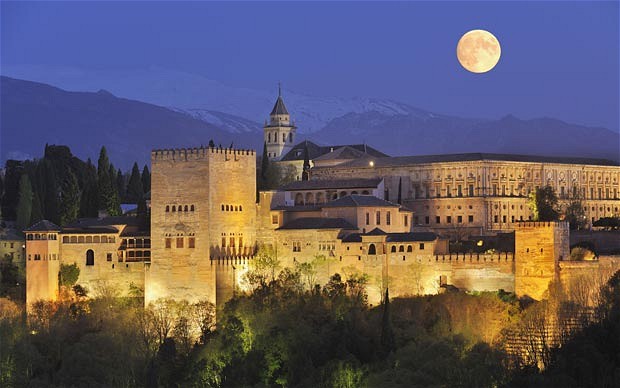
showing the vastness of the sight….we only saw it in the daytime
Alhambra is a huge fortress of moorish (Moors were Muslims from Northern Africa) design. The fortress is found on a large hill in Grenada, Spain..
Alhambra was built by Abdullah ibn Muhammad in 1238. He wanted the fortress to act as a stronghold in defense of the Christian advance. When he arrived on top of the hill there was already an old fortress. Abdullah decided to rebuild that fortress to hold his troops and than later add on a series of smaller palaces and housing to turn it into a castle.
Alhambra was built out of a mixture of sand rock and clay. Once it’s wet they put it into molds, let it dry then built, another layer on top. The problem with this is that in time the material erodes, and breaks down. To fix this the covered it in a kind of lime plaster to keep out water and protect from the wind.
The defensive possibilities on the hill were huge.
- From the top of the hill you could see the entire city of Grenada.
- The hill had steep inclines on two sides, a step drop on another, and the forth side was protected by the last of the Sierra Nevada Mountains preventing the enemy from entering.
In line with Muslim architecture, the Alhambra allows a secular peek into a different, and distant world. The outside walls are fortified and bare because in keeping with Muslim guidelines, you do not show your wealth to others. There are also few windows looking out of the building. We first encountered a small interior space without a roof, with a couple of orange trees and a fountain. The fountain was for washing up prior to entering the palace. The entry doors are small. When you enter, the palace, you turn left, then right, and you finally get to the main entrance, at one of the corners The hall immediately jogs to the right and the left, meant to slow down any intruders. After a reception hall with high windows which filter down the light with halls decorated in geometric shapes and Arabic phrases praising Allah. Images of people and animals were forbidden in design.
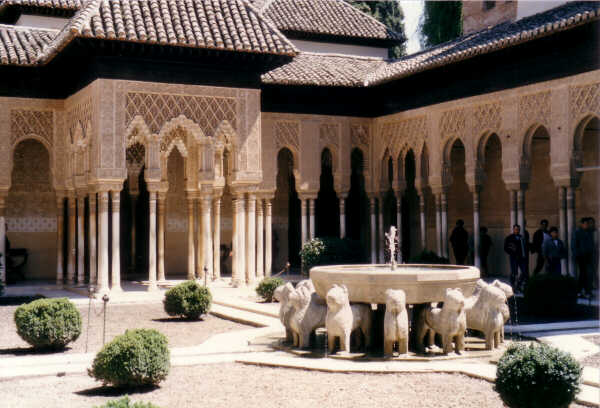
water flows along tiled streams in four directions from the fountains; originally one lion a hour spouted water and when we saw the recently restored lions; they all spouted water
The most beautiful rooms in the Alhambra was the Court of the Lions and Salon de Embajadores or the throne-room. The Court of the Lions is a huge courtyard located in the center of the Alhambra. Its described as the most feminine courtyard. I believe that this is because of the four gardens that used to be in the four corners of the court. The gardens are separated by four streams that all connect to the fountain in the center. The fountain is exquisite the base is surrounded by lions, and under the lions a small shallow pool of water that collects the water from the streams.
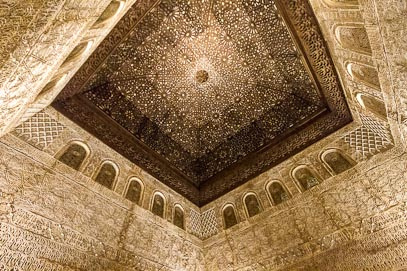
7th heaven
Salon de Embajadores has a wonder some wooden ceiling which represents the seven heavens a Muslim’s soul must pass through after death. It was an official room where business took place, sitting on mats which regularly drew ones eye upward. Due to this dome, much light fell on to the throne. The walls of this room are the most decorated: intricate plaster work of geometric designs with poems praising Allah worked in. The paint has faded, but this room is stunning .
We feel we haven’t done justice to describing this amazing complex called the Alhambra. At one point it was its own city contained within fortified walls, supporting around 2000 people. The had water shipped down the mountain which supported food gardens. There are many parts, many palaces built over 4 centuries. It’s difficult to keep tract of the various names given to the same space due to the various eras, rulers, religions who spoke or speak different languages to describe the vastness of architecture and art.
If you have the chance, we recommend you visit Alhambra. Watch a video in advance. If you have the privilege of getting a guide, get one who only speaks in English preferably with a Muslim background. You will get to know the wonder of the place.
The FIRST shared post by Aly and Nadine.