In the mid to late 1800s, art became of increasing importance as more money went to people instead of the church, and the amount of people who could buy art grew. More work got commissioned, and more citizens were buying. As your work no longer had to fit exact criteria, art itself got more innovative, and artists themselves got more common. And as it so happens, many of the Impressionistic artists of this time hung around Provence – including Nice and Aix, our current location and next destination.
If you stand anywhere in the Aix en Provence area, the panoramic view is only interrupted by buildings. The most famous part of the landscape would be the Montaigne Sainte-Victoire. It really is beautiful, and I’d assume that’s why it was painted by Paul Cézanne many times in his life.
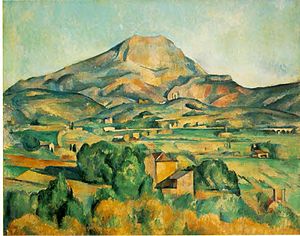
Cézanne’s Painting Of Mont Sainte-Victoire
It’s been said by several other notable artists, such as Picasso, that Cézanne was the main turning point In artistic styles – to cubism from impressionism. Cézanne’s artistic take on perspective – clearly seen in some of his paintings – is based on how an object is located in relation to other objects, instead of from the viewing point.
Henri Matisse was another big artist you fell in love with the area – he lived most of his life in Nice. When he had his intestinal cancer removed in 1941, it left him primarily bedridden – though with the help of an assistant could still do his work.
One thing that stands out about Matisse was the great number of mediums he used. Primarily a painter, he also drew a lot, and dabbled in sculpting. After a trip to America he began to use colored paper, and attaching it too a canvas. After his operation, this was the type of art he was still able to complete, by telling an assistant where to place the paper.
Pablo Picasso idolized Cezanne – to the point where he bought a castle where the other artist spent most of his time – the Provence area. He’s even currently buried under the front steps. Picasso, a Spanish artist, is known mostly for his cubist style paintings from his later work. When he was younger though, and in professional training, his realistic paintings showed a great skill. He traveled a lot, and developed many new techniques for using light in paintings. After a close friend died, Picasso entered his blue period – many of his paintings were featured in a blue or coral monotone. Eventually Picasso moved on to cubism – he once said of this transition, that “It took me four years to paint like Raphael, but a lifetime to paint like a child.”
Among these artists who enjoyed the charm of Provence, Emile Zola – an romance author and friend of Cézanne – spent his childhood there, and it’s rumored to have been a favored vacation spot for him, as well. It’s no surprise that Provence was, and is, such a visited spot. The South of France is truly beautiful area, and the pastries are really good here, too.